
A Chicago borrower is on your website at 10:40 p.m., three tabs deep into rate research, staring at your FHA calculator and wondering whether a two-flat in Logan Square is even in reach. They have exactly one question. There’s no one to ask, so they close the tab — and open the next lender’s site, where a chat bubble says hello.
Adding an AI chat widget to your mortgage website means putting a 24/7 conversational agent in the corner of every page that greets visitors instantly, answers their rate and payment questions, qualifies them on purchase vs refi, and books the consultation onto your calendar — automatically, at any hour. For a Chicago loan officer, it’s the difference between capturing that 10:40 p.m. borrower and donating them to a competitor. This is the step-by-step playbook: what the widget does, exactly how to add one, what it costs versus what a lost borrower costs, and how to keep it compliant.
The short answer: what an AI chat widget is and does
An AI chat widget is the small chat button that sits in the corner of your website. Click it and a conversational AI agent responds — not a canned “leave your email” form, but a real back-and-forth. For a mortgage loan officer, it greets the visitor, answers the question that brought them (“What credit score do I need for FHA?”, “What’s my payment on $340K?”), figures out whether they’re buying or refinancing, captures their contact details, and books a consultation onto your calendar. When you’re at a closing, asleep, or already on the phone, it’s the version of you that always answers.
It is not a phone tree and it is not a dumb “canned response” bot. A modern mortgage chat widget is trained on your loan programs, your service area, and your qualifying questions, so it can hold a genuine conversation, run a visitor through a light pre-qualification, and hand off to you (or your AI voice caller) when the borrower is ready to talk to a human. The point isn’t to replace the loan officer — it’s to make sure the first touch happens in the first few seconds, because on the web, the originator who responds first usually wins the file.
Why Chicago mortgage websites leak borrowers
Chicago is a deep, active purchase market — a typical Chicago home is worth roughly $325,000 as of mid-2026 (Zillow), with a constant churn of first-time buyers in the neighborhoods and move-up buyers in the collar suburbs. That means real traffic hitting mortgage websites at all hours. The problem is what happens to that traffic once it arrives.
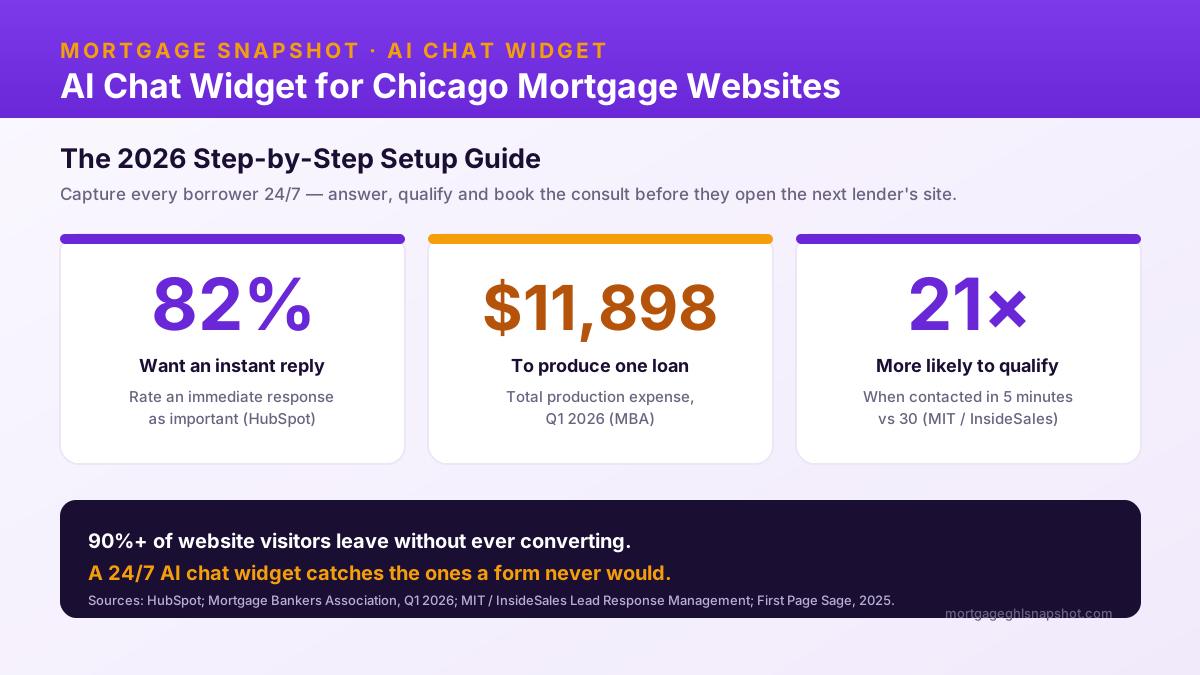
Most of it vanishes. Across financial-services websites, conversion rates typically sit in the low single digits, which means the large majority of visitors — often 90% or more — leave without ever identifying themselves (First Page Sage, 2025). They read a page, maybe poke at a calculator, and bounce. A static “Apply Now” button and a contact form only ever capture the small slice of visitors who were already ready to commit. Everyone else — the researchers, the 10 p.m. browsers, the “just checking if I qualify” crowd — slips away unseen.
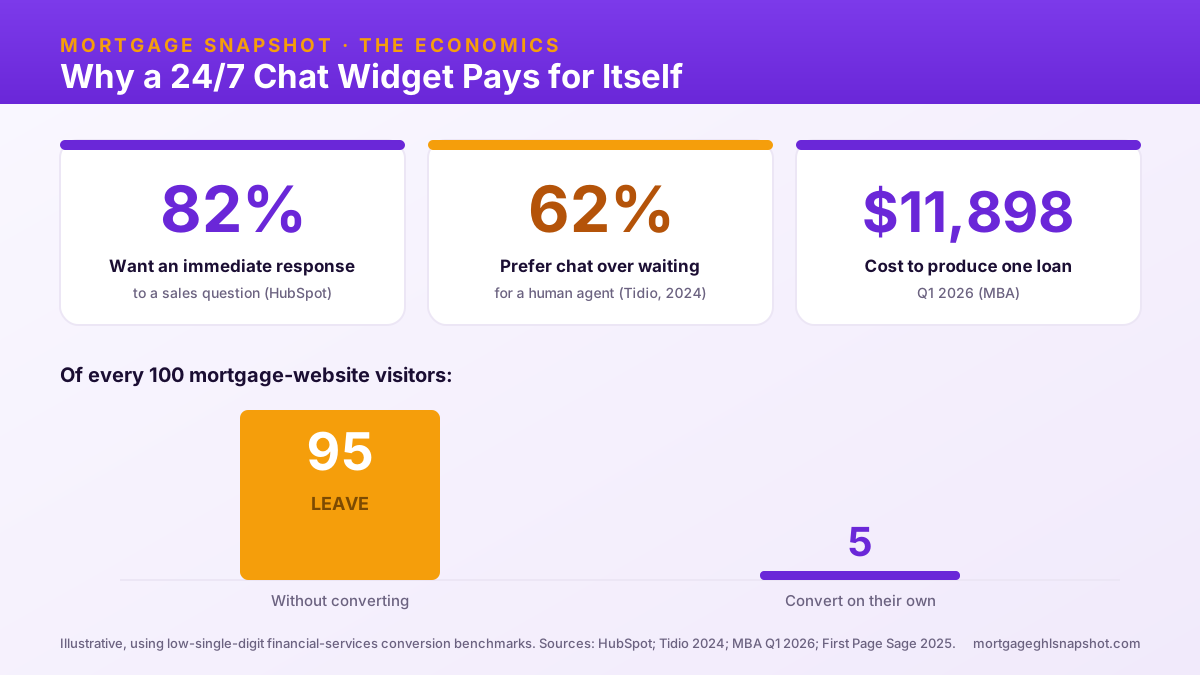
And borrowers today expect to be able to ask. HubSpot’s research found 82% of consumers rate an immediate response as important or very important when they have a sales question (HubSpot), while a Tidio survey found 62% would rather interact with a chatbot than wait for a human agent, largely because the bot is available around the clock (Tidio, 2024). Forrester’s research on online buyers found 44% say having their questions answered by a live agent mid-purchase is one of the most important features a site can offer (Forrester). Put simply: a mortgage website with no way to answer a question in the moment is fighting the way people actually shop.
Share of consumers, by expectation that a 24/7 chat widget is built to meet (%). Sources: HubSpot, Tidio 2024, Vonage 2024, Forrester.
The other half of the leak is timing. The most replicated finding in lead-response research is that speed is everything: the MIT/InsideSales Lead Response Management study of more than 15,000 leads found a web lead contacted within 5 minutes is 21× more likely to qualify than one contacted at 30 minutes (Lead Response Management), and Harvard Business Review’s audit of 2,241 U.S. companies found that responding within an hour made firms 7× more likely to qualify the lead than waiting even one hour longer (HBR, 2011). A form that lands in an inbox you check tomorrow morning has already lost. A chat widget answers in seconds — which is exactly the window that decides whether the borrower becomes a file.
What a mortgage AI chat widget actually does
“Answers questions” undersells it. A properly built mortgage chat widget runs a full front-desk workflow inside the conversation:
- Greets every visitor instantly, 24/7 — a proactive, friendly opener on the pages that matter (calculators, rates, program pages), so the borrower never has to hunt for a way to ask.
- Answers real mortgage questions — program basics (FHA vs conventional vs VA), ballpark payment and affordability, documentation, timeline — without quoting live rates or pre-approving anyone.
- Qualifies the borrower — purchase vs refi, target timeline, rough loan amount, first-time buyer status, and whether they’re pre-approved, so you know what you’re walking into.
- Books the consultation directly onto your calendar — the visitor leaves with a scheduled rate review or pre-qual call, not a vague “someone will reach out.”
- Captures and logs the lead into your CRM — every conversation becomes a tagged contact in GoHighLevel, which fires the right nurture sequence automatically.
- Hands off cleanly — when the borrower wants a human, it routes them to you, to a dedicated GHL VA, or to your AI caller for a live conversation.
Because it’s wired into GoHighLevel, the widget isn’t a standalone gadget — it’s the front door to your whole pipeline. A captured chat becomes a tagged contact, which triggers a pre-qualification follow-up sequence, which feeds your mortgage CRM. The AI Chatbot module that ships in Mortgage Snapshot does exactly this, and pairs with the widget’s calculators so a borrower who clicks “What can I afford?” gets an instant answer and becomes a lead in the same breath.
How to add an AI chat widget: step by step
Here’s the actual process, whether you build it yourself in GoHighLevel or have us do it for you. The five steps below are the same loop the widget runs every time a Chicago borrower lands on your site.
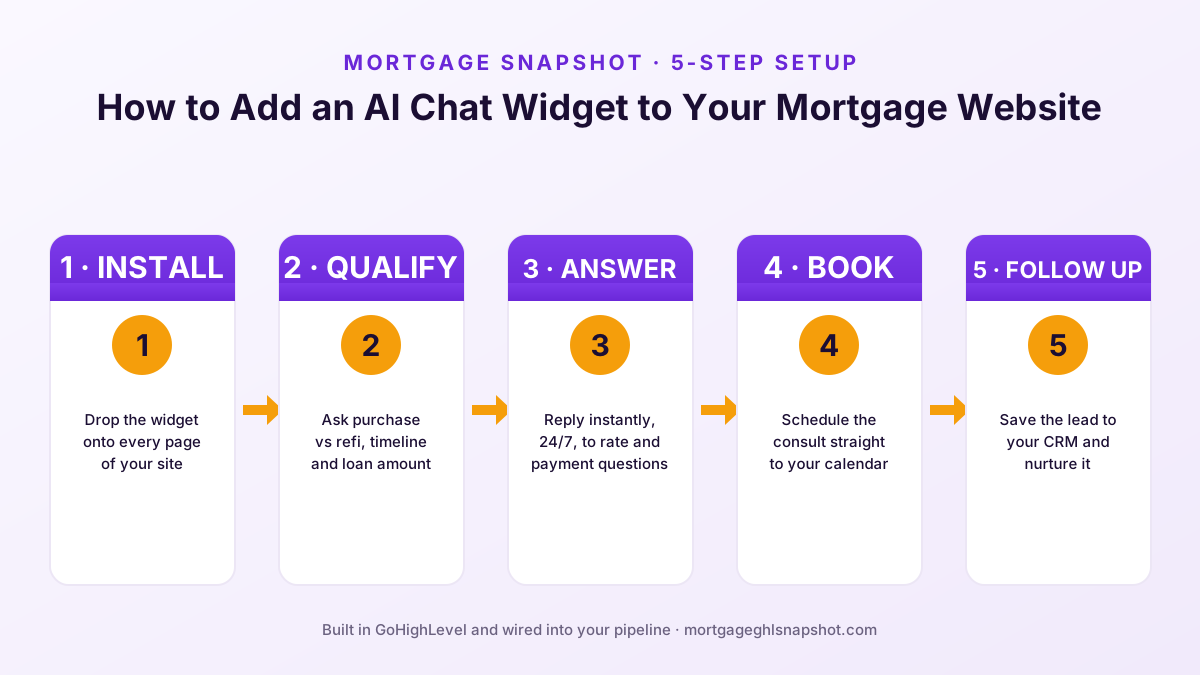
Step 1 — Install the widget on every page. In GoHighLevel, the chat widget is a snippet you enable and paste into your site (or it’s already embedded if your site is built in GHL). If you’re on an Astro or WordPress site, you drop the embed code into the global footer so it appears site-wide — not just the contact page. The single biggest mistake is burying chat on one page; it belongs everywhere a borrower can land from Google or an ad.
Step 2 — Give it a mortgage brain (train it to qualify). This is where a generic bot and a mortgage-tuned one diverge. You script the qualifying flow: purchase vs refi, target price or payoff, timeline, first-time buyer, and rough credit band. You feed it your programs (FHA, VA, conventional, jumbo, USDA), your service area, and clear guardrails — it estimates and educates, it never quotes a live rate or pre-approves. Well-written niche prompts qualify far better than a stock “How can I help?” bot.
Step 3 — Wire it to answer 24/7 and run your calculators. Connect the widget so it can trigger your white-label mortgage calculators inside the chat — a borrower asking “what’s my payment?” gets a real number and becomes a captured lead simultaneously. Set it to respond instantly at any hour; the whole value is that it never sends anyone to a “we’ll get back to you” dead end.
Step 4 — Connect booking to your calendar. Link the widget to your GoHighLevel calendar so a qualified borrower can book a consultation without leaving the chat. This is the step most DIY setups skip, and it’s the one that turns a conversation into a scheduled call. Pair it with appointment reminders and no-show recovery so the booked call actually happens.
Step 5 — Log to your CRM and trigger follow-up. Every chat writes a tagged contact into GoHighLevel and fires the matching automation — a purchase lead gets the buyer nurture, a refi lead gets rate-drop alerts, a not-ready-yet lead gets a long-term drip. Nothing lives and dies in the chat window; it all flows into the pipeline you already run.
AI chat widget vs live chat vs contact form
Loan officers usually weigh three ways to handle website visitors: a static contact form, human live chat, or an AI chat widget. Here’s how they actually compare for a mortgage workflow.
| Capability | Contact form | Human live chat | AI chat widget |
|---|---|---|---|
| Responds 24/7 | No — you reply later | Only when staffed | Yes, always on |
| Instant, in-the-moment answer | No | Yes, if someone’s free | Yes, in seconds |
| Qualifies purchase vs refi | Only what fields you add | Depends on the person | Yes — mortgage-trained |
| Books to your calendar | No | Manually | Yes — auto-books into GHL |
| Logs to your CRM | Sometimes | Manual, if at all | Yes — tagged & routed |
| Staffing cost | Low — but leaks leads | A person on every shift | Flat monthly, unlimited chats |
A contact form is cheap and quiet — and it only ever catches the borrower who was already ready to submit. Human live chat converts beautifully when it’s staffed, but no solo loan officer or small Chicago team can cover the phone, the pipeline, and a live chat window at 10 p.m. on a Sunday. The AI chat widget is the only option that answers instantly, qualifies, and books at any hour — for a flat, predictable cost instead of a salary per shift.
Keeping it compliant: consent, disclosure, TCPA
A careful loan officer asks about compliance second, and it’s the right question. A chat widget touches two things regulators and borrowers care about: how you capture and use contact information, and whether people know they’re talking to AI. Handled correctly, a widget is more defensible than ad-hoc manual messaging, because every interaction is logged and consistent. A few guardrails we build in from day one:
- Consent is captured in the flow. Before the widget collects a phone number for texting, it presents clear consent language and logs the opt-in — the same discipline covered in our mortgage text-message compliance guide. Any SMS follow-up runs through a registered A2P/10DLC number with STOP/opt-out handling.
- Disclosure is built into the greeting. The agent identifies itself appropriately and hands off to a human whenever the visitor asks — no pretending to be something it isn’t.
- Estimates stay estimates. The widget qualifies, educates, and books; it does not quote live rates, pre-approve, or give individualized advice. Those conversations belong to a licensed human, and the script routes them there.
- Everything is recorded. Transcripts, consent timestamps, and lead source are stored in GoHighLevel, so your outreach is auditable — the part a mortgage-niche build gets right and a generic bot vendor skips.
What it costs vs what a lost borrower costs
Here’s where “is it worth it?” gets answered. The Mortgage Bankers Association reports independent mortgage banks spent $11,898 in total production expense to produce a single loan in Q1 2026, while net production profit was just $727 per loan (MBA, 2026). Margins are razor-thin and every loan is expensive to originate — which makes the borrowers already visiting your site the cheapest ones you’ll ever win.
Illustrative: of every 100 mortgage-website visitors, how many convert vs leave, using low-single-digit financial-services conversion benchmarks. Source: First Page Sage, 2025.
Now line that up against a chat widget’s flat monthly cost. Whatever a Chicago loan officer earns on a single funded mortgage on a ~$325K home dwarfs that cost many times over — and the industry is spending nearly $12,000 just to produce each one. A widget doesn’t need to catch many extra borrowers to pay for a year of itself; in most Chicago pipelines, it needs to catch one. Everything after that is upside — the same logic behind reactivating your existing database: recovering a borrower who’s already in front of you is far cheaper than buying a new one.
The cheapest borrower you will ever close is the one already on your website asking a question. When margins are this thin and each loan is this expensive to originate, letting a curious Chicago visitor bounce because no one answered at 10 p.m. is one of the most expensive — and most preventable — mistakes a loan officer can make.
Frequently asked questions
What is an AI chat widget for a mortgage website?
It's a conversational AI agent that lives in the corner of your website and responds to visitors 24/7. For a loan officer, it greets the visitor, answers rate and payment questions, qualifies them on purchase vs refi and timeline, runs your calculators, books a consultation onto your calendar, and logs the lead into GoHighLevel. Our AI Chatbot module is exactly this, and our GHL development team can build a custom one tuned to your firm.
How do I add an AI chat widget to my mortgage website?
Five steps: (1) install the widget site-wide (embed the code in your global footer or enable it in GoHighLevel); (2) train it on your loan programs, service area, and qualifying questions; (3) wire it to answer 24/7 and run your calculators; (4) connect it to your calendar so borrowers can book in the chat; (5) log every conversation to your CRM and fire the right follow-up automation. You can build it yourself in GHL or have us install it for you.
Is an AI chat widget TCPA-compliant?
It can be, when it's set up correctly. Before collecting a phone number for texting, the widget presents clear consent language and logs the opt-in, and any SMS runs through a registered A2P/10DLC number with STOP/opt-out handling. The agent discloses that it's AI and hands off to a human on request, and it never quotes live rates or pre-approves. See our text-message compliance guide for the current rules.
Will a chatbot annoy my Chicago borrowers?
Modern widgets hold real conversations and hand off to a human whenever asked — and borrowers increasingly prefer them: 62% would rather use a chatbot than wait for a human agent (Tidio, 2024), and 82% rate an immediate response as important (HubSpot). Most visitors care far more that they got an instant answer at 10 p.m. than that the first response was AI.
Does an AI chat widget really pay for itself?
In most Chicago pipelines it needs to capture just one extra funded borrower a year to more than cover its flat monthly cost. Consider that independent mortgage banks spent $11,898 to produce a single loan in Q1 2026 (MBA, 2026) and that 90%+ of financial-services website visitors leave without converting (First Page Sage). Re-capturing even a fraction of that traffic makes the ROI lopsided in your favor.
How do I get one set up for my Chicago firm?
Two paths. Buy the Mortgage Snapshot and get the AI Chatbot as part of a complete GoHighLevel install in 24 hours, or have our GHL development team build a custom chat widget tuned to your site and wired into your account. Book a walkthrough and we'll scope it with you.
About the author
Emilio Duarte is a GHL Automation Lead for the mortgage niche, based in Tampa, FL. He builds GoHighLevel snapshots for mortgage brokers and loan officers, with a focus on borrower capture, pre-qualification flows, and speed-to-lead — wiring up the pipelines that turn raw website traffic into booked appointments without anyone touching a keyboard. Emilio is a fictional editorial persona for Mortgage Snapshot; nothing here is individualized legal, financial, or compliance advice. We are not a lender, and any figures cited are drawn from the sources linked.
Related reading
- Mortgage speed-to-lead: why the first 5 minutes decide the deal — the window a chat widget is built to protect.
- Mortgage calculators on your site — the tools the widget runs inside the chat.
- Pre-qualification follow-up that actually converts — where a captured chat goes next.
- Mortgage text-message compliance in 2026 — the TCPA rules behind chat-to-SMS follow-up.
- AI for mortgage loan officers — the broader playbook this fits into.